“I lived through five wars,” Hiba counts them on her fingers before looking up, as if checking she has not forgotten one. “I know what war is. I know what displacement is. I know what it means to lose everything. My earliest memory is of my father carrying me down the stairwell to a safe room.”
Today, Hiba is a Gender and Protection Manager with CARE, responding to families displaced by conflict in Lebanon. She is also one of them. For thirteen years, Hiba has worked in humanitarian response, two of those with CARE.
Since the recent escalation in Lebanon, her work has focused on emergency assistance for people forced to flee their homes. Every day she meets families trying to rebuild a life from whatever they managed to carry with them. When she returns home after work, she finds her own family living the same reality.
Originally from Nabatieh in southern Lebanon, one of the areas hardest hit by the conflict, Hiba has lived in Beirut since 2017. Her mother, brother and sister fled their home at the beginning of March and have been living with Hiba, her husband and their two young sons. “Our house in Nabatieh was damaged during the conflict. The other is still standing, but there is no water, no electricity.”
We cannot live in a destroyed home. Also there is no open supermarkets there and the attacks are still constant.
War as a mother
Loss is not new to Hiba. In August 2020, the Beirut port explosion tore through the city and destroyed three quarters of the building where she lived.
She rebuilt her life in a different district. Then war uprooted her family once again. “It hits different when you are a mother of small children and war breaks out. I was scared leaving my children at home, but I had to go to the office and keep working. I am a frontline worker, I am needed, but my sons need me as well.”
When the war escalated this year, she had to flee with one of her sons in her arms. “I did not know where to go. I had my baby in my arms and there was smoke everywhere. I did not know where to turn: The bathroom? The stairs? The street? The voices were so loud.” She does not call them sounds of war or noises. She calls them voices, ones she knows all too well. She pauses before describing them.
You can hear the plane coming above you. Hear it fire. You do not know where it will drop. Then you hear the hissing when the missile flies through the air. The loud boom of the impact. And then the building collapsing.
She takes a deep breath and continues: “I feel those voices throughout my whole body and often tense up and think: ‘I will hear the voices. I will hear it. It is coming.’ And then it does.”
Years of war have taught her to recognise every one of them. “I am used to war now, as I have felt all the tragedy before. But when it started in 2024, I could not bear the voices of war.”
Now her sons are beginning to hear them too.
When the bombs fall, my three-year-old calls out: ‘Mommy, mommy, it is thunder.’ And I answer: ‘Yes, it’s thunder.’ But then he looks out of the window and asks why there is no rain. And I say that it might just be fireworks. He is too small to understand war.
She remembers being that child herself. “Whenever there was war, when I was a child, my father would bring out the mattresses into the corridor and lay them close next to each other. We slept as a family. I felt safe like that. It is a good memory, as I did not understand war then.”
Now she is the one trying to create that feeling of safety. The next morning, she goes to work.
When you are in a war zone, you have to go into survival mode if you want to be able to help people.
Humanitarian workers are often expected to stand outside the crisis they respond to. In Lebanon, many CARE staff have been displaced themselves, worried about their own families while helping others reach safety, food, shelter and protection.
The guilt of being okay
For Hiba, two realities constantly collide. She remembers a distribution on a beach where displaced families had pitched makeshift tents because there was nowhere else to go. “Just a few hours later, that exact beach was bombed in the night.” The thought still haunts her. “We were so worried about the people staying there. They have nothing but a thin tent tarpaulin between them and the horrors of the sky. They sit on the sidewalk with nowhere to go. Some had phone numbers and we called them as we were so worried about them.”
Helping others does not make fear disappear. It simply gives it less room. “I started to drink a lot of coffee since the war escalated. When you cannot sleep at night because of the sound of the bombings or the constant buzzing of the drones, caffeine is the only way for me to function the next day,” Hiba says.
CARE introduced wellbeing sessions for staff. A chance to paint, work with clay, draw or simply talk for an hour. “One task was to draw something that represents us. I drew a cup of coffee,” she says, laughing.
The laughter is brief. Working with people who have experienced the same trauma she has lived through herself is both a burden and a source of strength.
Being able to help others takes away the guilt that you are safe and okay. So I do what I can to give back to people who are not.
That feeling of guilt became impossible to ignore during a distribution at a school in Beirut that had been turned into a shelter. “A woman asked me if I was from Nabatieh. She said ‘you used to come and buy shoes from me.’ She remembered me from when I was younger.” For a moment, the distance between aid worker and displaced person disappeared. “It was very heavy for me to meet her. And now I am the one assisting her.” Soon, Hiba plans to return to Nabatieh to support an aid distribution.
Hiba has been dreading that day. “Going home will destroy me. Seeing all that destruction and my neighbours suffering.” She has gone back only once since the ceasefire. “I took summer clothes and some photos from when I was small. Then security called us that we need to leave now. We could hear the bombs dropping behind us when we drove back to Beirut.”
The things she remembers are not only what has been destroyed, but of what existed before. “We had rivers. We had a beautiful scenery. Lovely hiking trails. Historic houses. It was like a city and village at the same time. We lived the best life there.”
The power of women
War destroys buildings. It also erases the ordinary places where life happened. The shoe shop you visited as a child, the streets where neighbours knew each other, the rivers, the cafés, the routines that quietly made a place feel like home.
For Hiba, humanitarian work is not about standing apart from that loss. It is about carrying it with her every day.
I am aiming for my sons to have an easier childhood than I had. Because war leaves scars and a deep pain that I cannot describe.
She looks at her children, then thinks of the women she meets every day through her work. “We as Lebanese have a very high tolerance, because we had to. We had no break since 2019. Especially women and mothers have superpowers.”
Then she adds quietly:
We worked so hard to build our lives, and no one has the right to take that from us.
It is the same determination that gets her up every morning after another sleepless night and sends her back to the families who need her.
We have the power as women to carry this pain on our shoulders and fight through it.
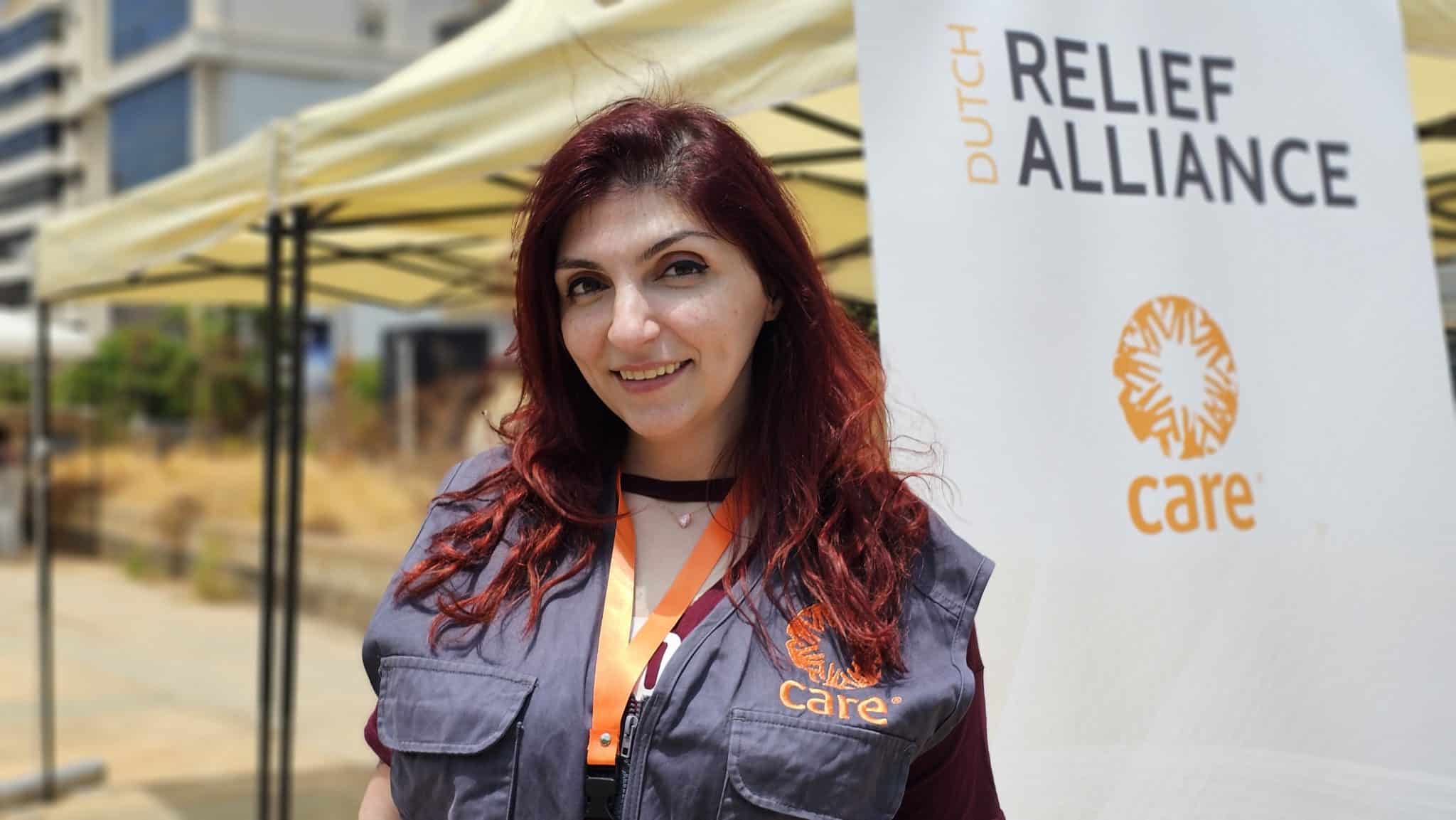
This story has been written by Sarah Easter, CARE Emergency Communications Officer, as part of the CARE’s World Humanitarian Day series.
About World Humanitarian Day
World Humanitarian Day (19 August) was originally designated by the United Nations General Assembly in commemoration of the 22 aid workers who lost their lives in a bomb attack in Baghdad in 2003. Every year, this date marks a moment to advocate for the survival, wellbeing and dignity of people affected by crises, and for the safety and security of aid workers.
Lebanon is facing one of the most severe impacts of the growing humanitarian crisis in the Middle East, with more than one million people displaced and shelters stretched nearly to capacity.
To continue supporting humanitarian responses to emergencies like the crisis in Lebanon, donate to CARE’s Global Emergency Fund today.